Skip to…
Marseille…this one was just Elliot – no Kirsty – on a quick solo hop (well, with a cricket team) from Manchester. The flight’s only about an hour and forty-five minutes, barely long enough to finish a podcast before landing in Marseille, where the air instantly feels warmer and saltier than home. Even at the end of September it was properly mild, the kind of warmth that makes wandering on foot a pleasure.
Hotel Centre La Juliette
We stayed at the B&B Hotel Centre La Juliette. Nothing fancy but central and comfortable, and the real treat was the patisserie just down the street. Breakfast both mornings was fresh pastries and coffee – the kind of start that makes you feel a city is on your side. Unless you’ve given yourself concussion the night before, but that’s a different story.
Old Port & Town Hall
The best way to get a feel for Marseille is to start at the Old Port (Vieux-Port). It’s the city’s hub, crammed with fishing boats, ferries and people lingering at café tables. From there, it’s a short walk to the Town Hall, a grand 17th-century building that reminds you Marseille has always been a place of trade, politics and power.
Cathédrale La Major
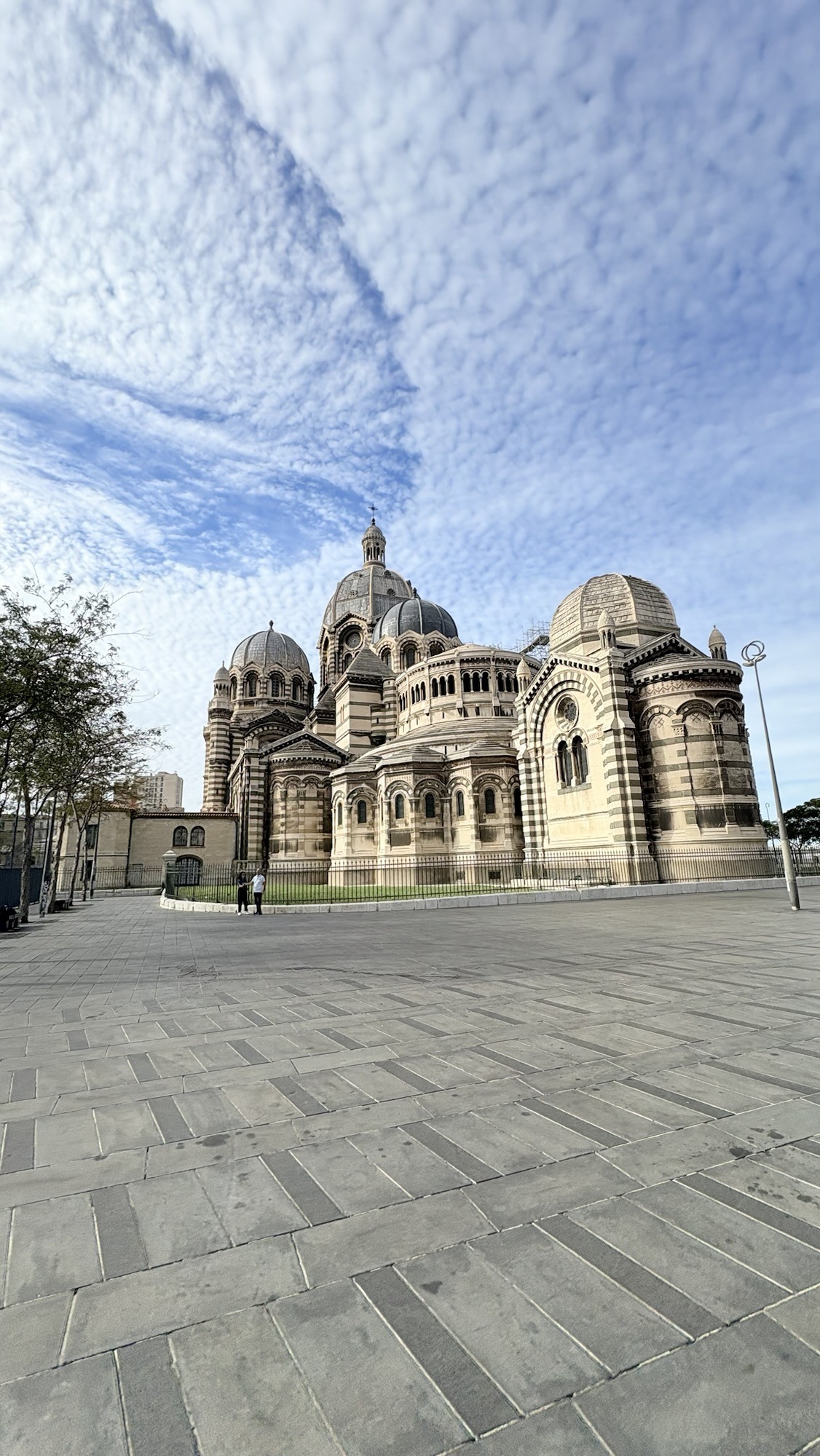
A little further on is the Cathédrale La Major, Marseille’s monumental 19th-century cathedral and one of the largest built in France since the Middle Ages. Its distinctive striped stone façade – creamy white Calissanne limestone banded with dark green and grey Florentine marble – feels almost out of place in a French port city, more reminiscent of the grand Byzantine basilicas of Ravenna or Venice. This blend of Byzantine and Romanesque revival styles was a deliberate choice, designed to symbolise Marseille’s long-standing role as a bridge between Europe and the Mediterranean world.
The cathedral you see today was completed in 1896, replacing a much smaller medieval church that had stood on the same site for centuries. Its sheer scale is striking: twin towers rise nearly 60 metres, while the central dome soars to over 70 metres high. Inside, the decoration is lavish yet solemn, with mosaics, marble columns, and intricately patterned floors that echo the influence of both Eastern and Western Christian traditions. It can hold as many as 3,000 worshippers, a reminder of Marseille’s population boom and its ambition during the height of France’s colonial expansion.
I didn’t go inside, but even standing in its shadow gives you a sense of the city’s layered history. The cathedral’s bulk looks out over the docks and the sea beyond – a fitting vantage point for a city that has always looked outward, welcoming new people, new faiths, and new ideas across the centuries.
Museum of European and Mediterranean Civilisations (MuCEM) & Fort Saint Jean
The standout exterior for me, though, was the Museum of European and Mediterranean Civilisations (MuCEM). The whole structure is wrapped in an intricate, twisted lattice of metal that looks like vines crawling over the walls. Opened in 2013 when the city was European Capital of Culture, it was designed by architect Rudy Ricciotti as a celebration of the complex historical, cultural and social exchanges that have shaped the Mediterranean basin. The museum’s main building is a dramatic cube of glass and steel wrapped in a delicate, lattice-like concrete skin that filters the intense southern light and casts shifting, patterned shadows across the walkways inside.
MuCEM is as much about the setting as the exhibits. It sits right on the waterfront at the entrance to the old port, connected to the 17th-century Fort Saint-Jean by a slender footbridge. The juxtaposition of old and new is deliberate, underscoring the museum’s focus on continuity and connection between past and present. Inside, the galleries explore themes ranging from ancient trade networks and shared religious traditions to modern migration, urbanisation and identity, bringing together archaeology, art, anthropology and contemporary history.
Even if you don’t go inside, it’s worth visiting for the architecture and the views alone. The rooftop terraces offer sweeping panoramas of the sea, the port and the city beyond, and the walkways between the museum and the fort feel almost like a sculpture in their own right – a fitting tribute to Marseille’s identity as a meeting point of cultures.It connects to Fort Saint Jean by a long skybridge, and as you walk across, the Mediterranean stretches out on one side and the city rises on the other. It’s modern and sculptural in a way that makes you stop and stare.
Welcoming & Warm
One thing you often hear about Marseille is its reputation for being rough or even violent. And yes, there are parts where that may be the case. But our group generally found it the opposite – welcoming, warm, and full of character. People were friendly, the atmosphere relaxed. Like any port city it probably has its edges, but that’s part of what gives it energy.
Two days felt like just the right amount. Enough time to wander, take in the sights and enjoy the warmth, but not so long you lose the buzz of discovery. Marseille might not be as polished as Nice or as showy as Paris, but it’s a city that feels real – and that, in itself, makes it worth the trip.
Pictures